
VIDA DE MARKETING
E INTELIGÊNCIA ARTIFICIAL
The New Frontier of Digital Visibility: A Manual on SEO, AEO, and GEO
The New Frontier of Digital Visibility: A Manual on SEO, AEO, and GEO
1. The End of the "Gambiarra" Era: Why Traditional Search isn't Enough
The obsolescence of the linear funnel is absolute. For years, digital marketing has survived on "gambiarra"—a culture of makeshift improvisation and fragmented tools. This era of manual patchwork is being replaced by the Agêntic Operating System (S.O.I.A.), a transition from a series of static pages to a living ecosystem of systemic intelligence.
In this new paradigm, the bottleneck is no longer "access to information," but the "speed of execution.
" Entrepreneurs must stop consuming passive theory—watching endless classes—and start activating agents.
You do not need to learn how to build the machine; you need to turn it on.
Feature
Traditional Improvisation (Gambiarra)
Systemic Intelligence (S.O.I.A.)
Execution Speed
Dependent on human timelines; slow and manual.
24/7 operation; near-instant high-quality outputs.
Learning Model
Passive Theory: Watching hours of video lessons.
Active Execution: Activating agents with built-in expertise.
Consistency
Fragmented; tools and silos create "money leaks."
Integrated; a cohesive biological architecture of 100+ agents.
Strategy
Linear Funnel; the relationship ends at the transaction.
The Trophy; focus on exponential retention and cross-selling.
Navigating this new system requires a fundamental shift in how we perceive the digital architecture of a brand, moving through three distinct pillars of modern visibility.
2. Decoding the Visibility Trio: SEO, AEO, and GEO
Digital visibility is no longer a battle for "blue links" on a search result page. It is a pedagogical mission to train the AI engines that now serve as the primary gatekeepers of information. We are moving from appeasing an algorithm to educating a synthetic employee.
SEO (Search Engine Optimization): The structural foundation. It ensures Google’s spiders can crawl and index your content for traditional keyword-based searches.
AEO (Answer Engine Optimization): The strategy of providing "direct answers" to Large Language Models (LLMs) like ChatGPT and Claude. The goal is for the LLM to mention your brand as the definitive solution.
GEO (Generative Engine Optimization): Optimization for generative search engines like Perplexity and Gemini, which synthesize multiple sources to provide comprehensive overviews.
The "So What?" The objective is no longer simply "getting a link." Your website must now function as a training manual for AI. By structuring your data correctly, you are educating the LLM so it becomes your brand's most senior pre-sales agent, recommending your services to users with precision and authority.
Transitioning from a storefront to an educational source for AI requires a rigorous semantic architecture.
3. The Architecture of Authority: Semantic Organization and Schemas
To become "eligible" for AI answers, a business must be structured for machine comprehension. The Antigravity case study demonstrates this shift: in a single audit, a site was transformed from a "Red/Yellow" status to a "Green/B-grade" ranking by addressing technical and semantic gaps.
Technical Insight: The Model Content Protocol (MCP) and Schema codes are the hidden languages of the modern web. They act as the "connective tissue" that allows an LLM to "see" and identify specific entities—products, expertise, and services—without hallucination.
The Antigravity audit identified three critical technical pillars for AI indexing:
- Page Speed Performance: Improving performance from a baseline of 74% to high-efficiency levels. AI engines prioritize sites that deliver data with zero friction.
- Semantic FAQ/FAC Clusters: Moving beyond random blog posts to logical question-and-answer clusters that LLMs use as primary sources of truth.
- Entity Identification: Using structured data to achieve a 91% structure score, ensuring the AI identifies the brand as a verified entity in its knowledge graph.
4. The H+A Methodology: Human + Agent Orchestration
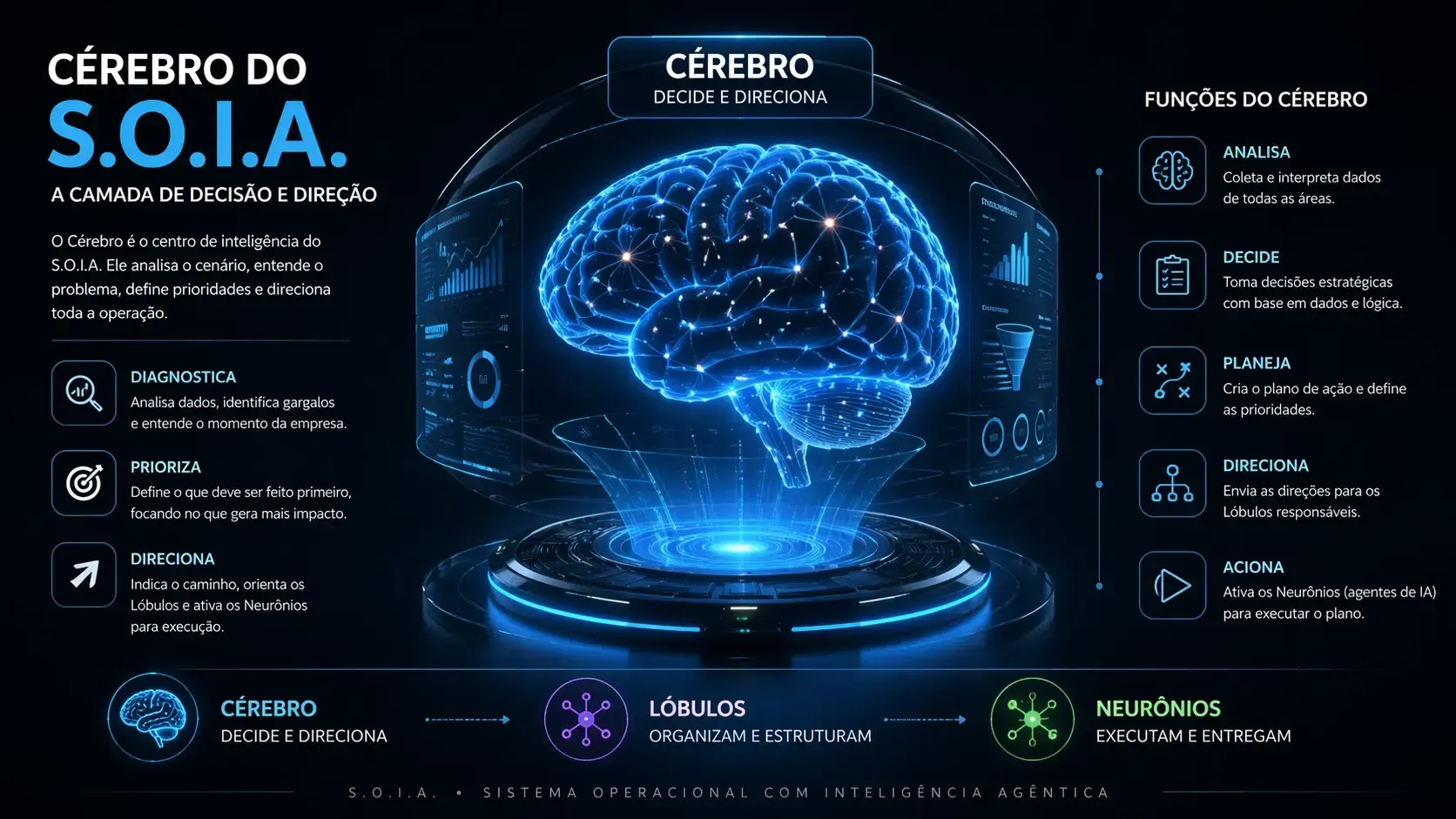
The S.O.I.A. system is defined by its Biological Architecture, a methodology known as H+A (Human + Agent).
In this orchestration, the Human provides the Problem + Expertise (the business context), while the Agent provides the Action + Output (the execution).
These agents are not merely software; they are "years of senior commercial intelligence" embedded into code.
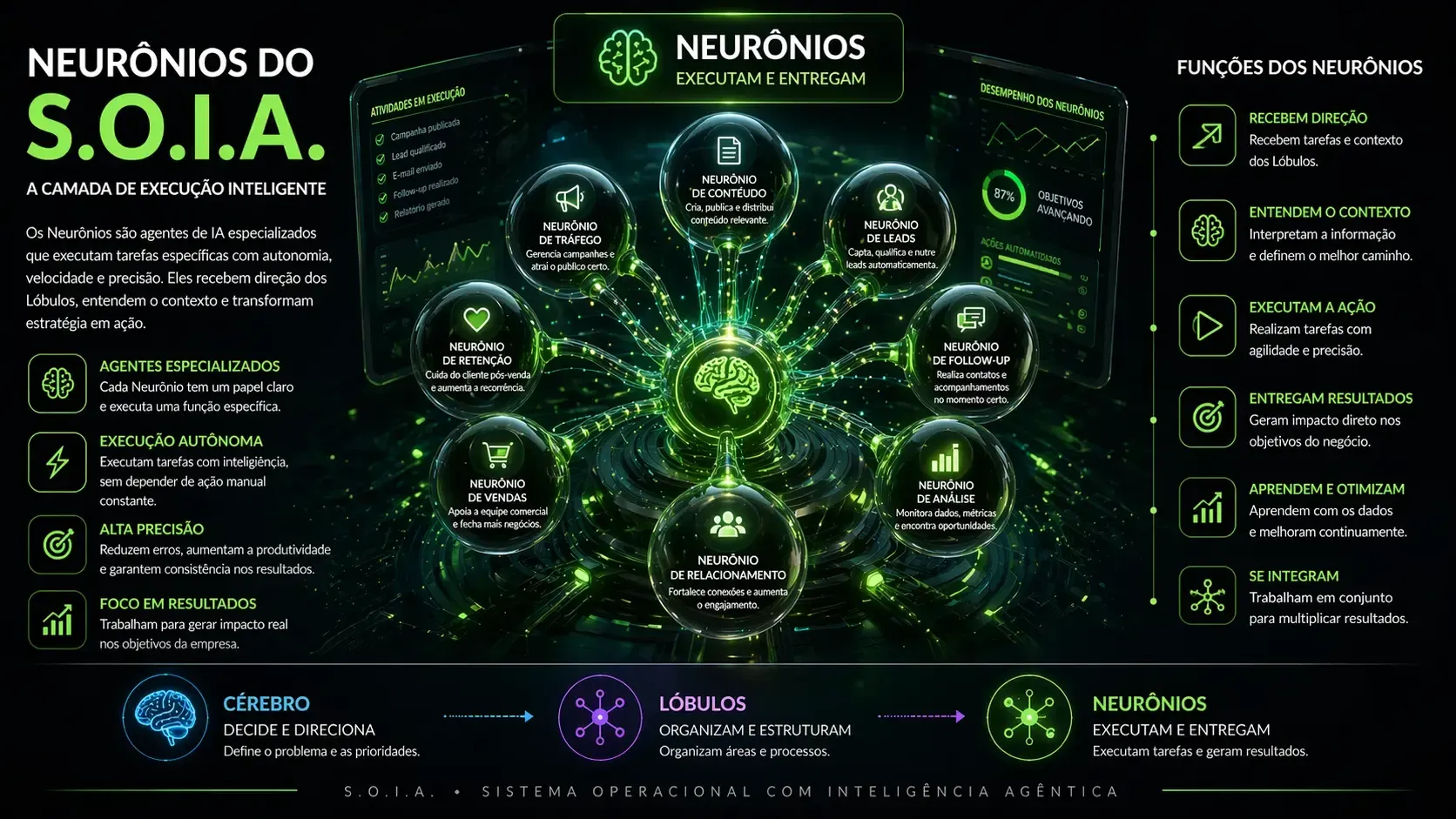
The S.O.I.A. biological structure consists of:
- The Brain: The central diagnostic unit that manages logic and strategy.
- The Lobes: Specific thematic departments (Marketing, Sales, Retention, Growth, etc.).
- The Neurons: 100+ specialized agents (the "digital employees") that execute specific tasks, from writing copy to handling objections.
This architecture replaces the human need for technical mastery with the human need for strategic direction, fundamentally shifting the business focus from "how to do it" to "what needs to be done."
--------------------------------------------------------------------------------
5. From the Funnel to the Trophy: The Modern Sales Journey
Traditional marketing relies on a linear funnel where leads are often lost after the first transaction. The S.O.I.A. model introduces the "Trophy" model, which prioritizes the exponential growth of the customer base through continuous retention.
- Attraction: Utilizing the SEO/AEO/GEO trio to pull leads into the ecosystem.
- Conversion & Relationship: Using agents to nurture and turn cold leads into Marketing Qualified Leads (MQLs).
- The Sale: The transaction point, supported by AI objection-handlers.
- Retention (The Growth Engine): The wide base of the Trophy. The customer "never leaves" because the system is designed for constant up-selling and cross-selling.
To navigate this journey, agents utilize the MEDIR diagnostic framework:
- Moment: Where is the business now?
- Expectation: What is the goal?
- Dor (Pain): What is the specific bottleneck?
- Impact: What is the cost of inaction?
- Resolution: What is the specific agent-led solution?
--------------------------------------------------------------------------------
6. Practical Implementation: The 30-Day Onboarding Roadmap
Moving from manual improvisation to agêntic intelligence requires a 30-day "implementation brutalism" approach—focusing on action over theory.
The 4-Week Sprint Checklist
- [ ] Week 1: Diagnostic and Logic – Identifying money leaks and setting the Brain's strategy.
- [ ] Week 2: Marketing & Sales Activation – Plugging in agents to generate immediate traction.
- [ ] Week 3: Retention Implementation – Protecting the base and automating repeat sales.
- [ ] Week 4: System Scale – Transitioning the Human role from "operator" to "machine manager."
The Value Proposition The logic of the S.O.I.A. system is built on accessible high-level intelligence. When you break down the investment (R$ 997 / 12 months / 100 agents), the cost is approximately 83 cents per agent per month. The value is not in the access to AI, but in the Senior Commercial Intelligence pre-loaded into these digital employees.
Final Statement: The urgency to move from procrastination to implementation is dictated by the market. As AI becomes the primary filter for all consumer decisions, businesses still operating on "gambiarra" will become invisible. Activate your digital orchestra today or be silenced by those who have.
What is SEO, AEO and GEO?
SEO focuses on ranking in search engines.
AEO focuses on being selected as direct answers.
GEO focuses on being cited by AI-generated responses.
Frequently Asked Questions
What is the difference between SEO, AEO and GEO?
SEO focuses on improving visibility in traditional search engine results. AEO focuses on structuring content so it can be selected as a direct answer. GEO focuses on optimizing content to be cited, summarized or referenced by AI-powered search and generative systems.
Is SEO still relevant in the age of AI?
Yes. SEO is still relevant because search engines continue to index, rank and evaluate websites. What has changed is that SEO alone is no longer enough. Brands now also need AEO and GEO to increase visibility in AI-driven answers and generative search experiences.
What is AEO?
AEO stands for Answer Engine Optimization. It is the practice of structuring content so that search engines, assistants and AI systems can identify and deliver it as a direct answer to user questions.
What is GEO?
GEO stands for Generative Engine Optimization. It refers to optimizing content so that AI systems such as ChatGPT, Gemini and other generative platforms can interpret, trust and reference it in their responses.
How do you rank in AI search engines?
To increase visibility in AI-powered search, content should be clear, well-structured, semantically relevant and authoritative. Definitions, FAQs, concise explanations, internal links and consistent topical authority all help improve discoverability in AI-generated answers.
What makes content more visible to AI systems?
AI systems tend to favor content that is structured, easy to interpret and rich in context. Pages with direct definitions, question-and-answer sections, clear headings, helpful examples and semantic consistency are more likely to be cited or summarized.
How can businesses prepare for the future of search?
Businesses should move beyond traditional SEO and build a broader visibility strategy that includes SEO, AEO and GEO. This means creating helpful content, answering real questions, organizing knowledge clearly and building authority across search engines and AI systems.
Why is digital visibility changing?
Digital visibility is changing because users are no longer relying only on traditional search results. They are increasingly asking questions directly to AI systems, assistants and answer engines. This shifts the focus from simply ranking pages to becoming the source behind the answer.
What is the future of search?
The future of search is hybrid. Traditional search engines still matter, but AI-generated answers, conversational discovery and answer-based interfaces are becoming central. Brands that want to stay visible must be understood not only by Google, but also by AI systems.
How does this relate to business growth?
Visibility influences discovery, authority and demand generation. Businesses that are easier to find in search engines and AI systems are more likely to be remembered, trusted and chosen during the buying journey.
Are you visible in AI?
→ Join the movement

Vida de Marketing e Inteligência Artificial